Kids who feel connected with nature are happier -- and better-behaved
© 2022 GWEN DEWAR, PH.D., ALL RIGHTS RESERVED
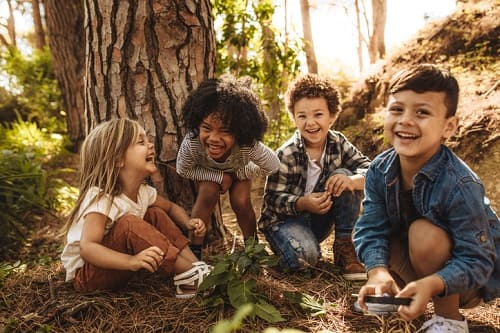
Does your child experience connected with nature? Researchers can mensurate these feelings with a standard questionnaire, and they've discovered fascinating links. Nature-loving children are happier. They experience fewer behavior problems. And they are more probable to treat others with kindness.
What happens when we spend time outdoors in natural spaces?
Good things!
Studies suggest that nature experiences can defuse toxic stress and promote skillful health. They can improve our moods and renew our ability to concentrate. They might even protect united states of america from developing psychiatric problems.
(Read more nearly it in this Parenting Science article.)
But are the furnishings the aforementioned for everyone? Possibly not.
Afterward all, people have dissimilar attitudes about nature. Some feel an emotional or spiritual connexion with nature. Others don't. Do these feelings make a deviation to our well-being?
It looks that way. Feeling connected to nature is linked with better psychological outcomes.
For example, researchers in Canada asked thirty,000 adolescents if they were experiencing emotional problems or symptoms of stress (Piccininni et al 2018).
The kids answered questions about irritability, nervousness, depression, sleep disturbance, and frequent headaches. In addition, the kids rated their feelings nearly the natural world.
And researchers discovered a telling link:
Compared with kids who were relatively indifferent, adolescents who rated their connexion with nature as "important" had a 25% reduction in stress-related symptoms.
In a smaller written report of approximately 300 main school children in Mexico, researchers plant that kids with strong feelings of connectness to nature tended to study higher levels of happiness (Barrera-Hernandez et al 2020).
And parallel results have been reported in a wide range of adult surveys. Across 30 published studies on adult well-being, connection to nature has been linked with greater feelings of happiness and vitality (Capaldi et al 2015).
Non surprisingly, connectedness to nature has as well been linked with greater feelings of responsibility toward the environs.
Adults who feel connected to nature take more actions to protect and preserve it (Geng et al 2015), and it's likely that kids experience a similar effect.
In that survey of Mexican children, feelings of connecteness to nature were strongly correlated with pro-ecological behavior (like conserving household resources).
And in a Swedish written report, researchers found that 10-year-old children adult stronger feelings of responsibility and care toward wildlife after they helped rescue a local amphibian species from a human-made hazard.
Ii years later, these kids still reported feeling increased sympathy and concern for the creatures (Barthel et al 2018).
But there is likely much more. Kids who honey nature aren't just happier and more than invested in protecting the environment. They besides seem to be better-behaved — and more than caring — towards their beau man beings.
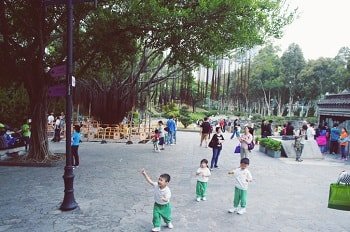
For prove, consider a study by Tanja Sobko and her colleagues — a written report of families living in Hong Kong.
Hong Kong is intensely urban, but it's dotted by many parks and greenish spaces. In fact, 90% of the population lives within 400 meters of i of these small "nature zones."
So in that location are many opportunities for outdoor activities and nature experiences. Does nature play an important role in children'south lives? And, if and then, does a kid'southward feelings virtually nature predict his or her beliefs toward other human beings?
To reply, Sobko and colleagues recruited more than 200 parents of young children — kids betwixt the ages of 2 and five. And the researchers asked parents to fill out two unlike questionnaires.
One was a standard screening tool called the "Strengths and Difficulties Questionnaire." It measures behavioral and emotional adjustment. Parents were asked if their children experienced
- behave problems (like fighting or adulterous)
- peer issues (like peer rejection, or a lack of friends)
- emotional problems (like frequent fears, or angry outbursts), and
- attending problems (like difficulty staying focused and completing tasks).
In add-on, parents were asked to appraise the caste to which their youngsters behaved prosocially, i.e., whether their kids were
- considerate of other people'south feelings
- helpful if another child is hurt, upset, or feeling ill
- kind to others; and
- ready to share with other kids.
The second questionnaire, called the "Connectedness to Nature Index for Parents of Preschool Children," or CNI-PPC, asked parents to rate their agreement with statements about their children'due south
- enjoyment of nature,
- empathy for nature,
- responsibility for nature, and
- sensation of nature.
For example, parents read statements similar "Existence in nature makes my kid peaceful" (a measure of "enjoyment of nature"), and they indicated whether the statements were true, only somewhat true, or non at all true.
I've copied some additional sample items in the box below. They will aid you better understand what the researchers were looking for. They likewise offering some idea-provoking questions for y'all to ask about your own kid.
Sample items from the Connectedness to Nature Index for Parents of Preschool Children
Are these statements true, just somewhat true, or not at all true?
ENJOYMENT OF NATURE:
- My child likes to hear different sounds in nature.
- My kid likes to encounter wild flowers in nature.
- My child likes to garden and plant.
- My child enjoys collecting rocks and plants.
EMPATHY FOR NATURE:
- My child feels sad when wild animals are hurt.
- My child is distressed when he or she sees animals beingness hurt.
- My child is heartbroken when animals pass away.
RESPONSIBILITY FOR NATURE:
- My child believes that picking up trash can assist nature.
- My kid treats plants, animals, and insects with care.
- My child enjoys recycling paper and bottles.
Sensation OF NATURE:
- My child notices wild fauna wherever he or she is.
- My kid notices birds and other sounds in nature.
- My child chooses to read almost plants and animals.
So what were the results of the study? What did the researchers discover?
Three of the "connectedness" factors — enjoyment of nature, responsibleness for nature, and sensation of nature — were directly related to preschoolers' behavior, and some of the effects were large.
For instance, responsibility toward nature explained about 70% of the variation in conduct issues and prosocial behavior. It explained approximately 60% of the variation in peer problems, and twoscore% of the variation in children'southward tendencies to be hyperactive or inattentive.
Enjoyment of nature had a widespread impact across the spectrum of social and emotional functioning, explaining nearly 50% of the variation among children.
And awareness of nature explained approximately 50% of the observed variation in children's emotional problems.
What about empathy for nature?
That, too, was strongly linked to social and behavioral problems, but the path was indirect.
Children who scored high on empathy for nature tended to score high on responsibility toward nature, and information technology was responsibility– a factor emphasizing a child's actions — that best predicted a child's behavior and social-emotional status.
What explains these links?
Why was connectedness to nature linked with better child outcomes?
The researchers caution that they didn't collect information on the parents' socioeconomic status and parenting styles. They didn't enquire parents about their ain, personal attitudes toward nature.
And it's sure bet that parental characteristics explain at to the lowest degree some of the results here.
For instance, kids who are connected with nature may be more probable to accept parents who actively support the development of prosocial behavior. Their parents might make better employ of strategies that help young children hone social skills (see opens in a new windowthis Parenting Scientific discipline article for tips on fostering preschool social skills).
It likewise seems likely that family stress (including economic stress) plays a function.
Parents who are stressed-out are more probable to accept children with beliefs problems. And if you're stressed-out, are y'all going to invest as much time and energy in helping your child feel connected with nature? Maybe not.
Then, too, nosotros mustn't forget that this written report didn't evaluate children directly. Researchers are relying on parental reports.
Parents know a lot about their children, but they are imperfect witnesses, and they might get some things wrong.
Yet some other study — 1 that questioned children directly — indicates that nature-loving kids are more probable to treat people with kindness and respect.
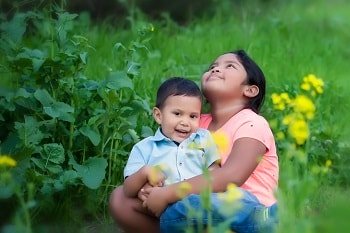
In their study of Mexican schoolhouse children — ranging in age from 9 to 12 years — Laura Barrera-Hernandez and colleagues found that "connexion to nature" tended to predict self-reported altruism and fairness.
Kids who scored high on connectedness were more likely to agree with statements like
- "I help someone who falls or gets hurt,"
- "I care for all my classmates equally equals," and
- "I explain or aid schoolmates with their homework or tasks they do not empathise."
This report, like the Hong Kong written report, didn't control for parental characteristics or socioeconomic condition, so we even so tin't know how these factors might have afflicted the results.
But regardless, we're still left with the links.
In the Hong Kong study, parents who perceived lots of nature connectedness in their preschoolers too reported improve child outcomes.
In the written report of Mexican school children, kids who scored high on connectedness besides expressed more than friendly, egalitarian, prosocial attitudes.
If nothing else, we have evidence that "connexion to nature" is a predictor of better behavior. It'southward a good sign.
And given what we already know about the benefits of green infinite, nosotros take every reason to nurture our children's positive feelings toward the natural world.
If kids grow upwards feeling continued with nature, they will be more probable to seek out nature experiences. And, as I've explained opens in a new windowelsewhere, experiments indicate that nature experiences tin can reduce stress, dispel bad moods, restore concentration.
What happens when we've got all these good things going for us?
We tend to be more pleasant, considerate, attentive.
So information technology makes sense that connecting with nature could pb usa to become more than prosocial — more than likely to help, share, and befriend.
What can we do to aid children feel continued with nature?
Kids need to experience nature, that's obvious. Just you lot shouldn't feel helpless if you lot alive in a city, or lack a private light-green infinite.
Those preschoolers in the Hong Kong report were growing upwardly in 1 of the almost densely populated places on world, and all of the kids lived in apartments. Yet they still developed strong feelings of connectedness to nature.
- So visit local parks, and whatsoever trivial pockets of nature yous tin find. Fifty-fifty a view out the window — or time spent tending your own, small-scale container garden — is helpful. And then, too, are virtual nature visits: Expose your kid to the grandeur of nature through exciting nature documentaries and photographs.
- Help kids tune into nature past providing them with goal-based activities. Ask kids to search for interesting insects, seeds, or rocks. Encourage immature children to spot signs of wildlife with these opens in a new windowtracking activities.
- Encourage kids to communicate their nature experiences through writing, artwork, or photography. As I volition explain in an upcoming post, there's show creative projects tin deepen a child's connection with nature.
- Have steps to annul negative cultural messages that your child encounters about wildlife. Studies confirm that folk attitudes most specific creatures (due east.yard., "toads are disgusting,") can prejudice us against wild animals (Brom et al 2020;Ceríaco 2012). So model curiosity, respect, and enthusiasm — non negativity.
- Learn more most wild fauna, and get involved in the protection of local wild animals. People feel more continued with nature when they can identify the species they see. And remember those children in Sweden who helped relieve a local amphibian species? Participation in wild fauna conservation helps us deepen our sense of connectedness.
For more, see my article, opens in a new window"How to connect with nature: Tips for tuning into the natural globe."
Boosted reading
Want to know more virtually the science in favor of light-green spaces? Run into my article, opens in a new window"Green spaces benefit mental wellness."
In addition, see this Parenting Science commodity almost the many benefits of outdoor play, besides equally my show-based guide, opens in a new window"Outdoor learning and dark-green time: How kids benefit from learning and playing in nature."
References: Kids connected with nature
Amicone Yard, Petruccelli I, De Dominicis S, Gherardini A, Costantino V, Perucchini P, Bonaiuto M. 2018. Greenish Breaks: The Restorative Outcome of the Schoolhouse Environment'south Green Areas on Children's Cognitive Performance. Forepart Psychol. 9:1579
Barrable A and Berth D. 2020. Increasing Nature Connection in Children: A Mini Review of Interventions. Forepart Psychol. eleven:492.
Barrera-Hernández LF, Sotelo-Castillo MA, Echeverría-Castro SB, Tapia-Fonllem CO. 2020. Connexion to Nature: Its Impact on Sustainable Behaviors and Happiness in Children. Front Psychol. xi:276.
Barthel S, Belton S, Raymond CM, Giusti M. 2018. Fostering Children'southward Connection to Nature Through Accurate Situations: The Example of Saving Salamanders at Schoolhouse. Front end Psychol. 9:928.
Brom P, Anderson P, Channing A, Underhill LG. 2020. The role of cultural norms in shaping attitudes towards amphibians in Cape Town, South Africa. PLoS 1. 15(2):e0219331.
Bruni, C. Yard., Wintertime, P. Fifty., Schultz, P. W., Omoto, A. Yard., & Tabanico, J. J. (2017). Getting to know nature: evaluating the effects of the Become to Know Program on children's connectedness with nature. Ecology Instruction Inquiry, 23(1), 43–62.
Capaldi CA, Dopko RL, Zelenski JM. 2014. The relationship between nature connectedness and happiness: a meta-analysis. Front Psychol. 5:976.
Ceríaco LM. 2012. Human attitudes towards herpetofauna: the influence of folklore and negative values on the conservation of amphibians and reptiles in Portugal. J Ethnobiol Ethnomed. viii:8.
Cox DT and Gaston KJ. 2016. Urban Bird Feeding: Connecting People with Nature. PLoS One. 11(7):e0158717.
Cox DT and Gaston KJ. 2015. Likeability of garden birds: Importance of species knowledge and richness in connecting people to nature. PLoS Ane. 10(xi):e0141505.
Joye Y and Bolderdijk JW. 2015. An exploratory written report into the effects of boggling nature on emotions, mood, and prosociality. Front Psychol. 5:1577.
Lumber R, Richardson Chiliad, Sheffield D. 2017. Beyond knowing nature: Contact, emotion, compassion, meaning, and beauty are pathways to nature connection. PLoS Ane. 12(5):e0177186.
Marczak M and Sorokowski P. 2018. Emotional Connectedness to Nature Is Meaningfully Related to Modernization. Bear witness From the Meru of Republic of kenya. Front Psychol. ix:1789.
Mayer FS and Frantz, CM. 2004. The connectedness to nature scale: a measure out of individuals' feeling in customs with nature. J. Environ. Psychol. 24, 503–515.
Ng HKS, Hong YL, Grub TS, Leung ANM. 2019. Nature Does Not E'er Give You a Helping Mitt: Comparison the Prosocial Effects of Nature at Different Resources and Security Levels. Pers Soc Psychol Bull. 45(4):616-633.
Olivos-Jara P, Segura-Fernández R, Rubio-Pérez C, Felipe-García B. 2020. Biophilia and Biophobia as Emotional Attribution to Nature in Children of five Years Sometime. Front Psychol. 11:511.
Richardson M, Hussain Z, and Griffiths Dr.. 2018. Problematic smartphone use, nature connectedness, and anxiety. J Behav Addict. 7(1): 109–116.
Rosa CD, Profice CC, Collado S. 2018. Nature Experiences and Adults' Self-Reported Pro-environmental Behaviors: The Role of Connectedness to Nature and Babyhood Nature Experiences. Front Psychol. nine:1055.
Sobko T, Jia Z, and Brown G. 2018. Measuring connectedness to nature in preschool children in an urban setting and its relation to psychological functioning. PLoS One. 13(11):e0207057.
Wells Due north and Lekies K. 2006. Nature and the life course: pathways from childhood nature experiences to adult environmentalism. Child. Youth Environ. 16: 2–25.
White RL, Eberstein K, Scott DM. 2018. Birds in the playground: Evaluating the effectiveness of an urban environmental pedagogy project in enhancing school children'due south awareness, knowledge and attitudes towards local wildlife. PLoS One. xiii(iii):e0193993.
Image credits for "Kids who experience connected with nature":
Title image of children under the trees by jacoblund/istock
image of park in Hong Kong by lavendertme / istock
image of big sister hugging petty brother by mmg1design / istock
Content terminal modified vii/i/2020
schweigerwifer1939.blogspot.com
Source: https://parentingscience.com/kids-connected-with-nature/
0 Response to "Kids who feel connected with nature are happier -- and better-behaved"
Postar um comentário